Quick answer:
PPD or postpartum depression is a medical condition where a woman feels extremely depressed, anxious or void after giving birth to a child and such feelings don’t disappear within a few days, as usually happens with fatigue. Postpartum depression can begin right after childbirth or even after several months. Such condition may affect the ability to sleep, eat, and look after the newborn baby. The disease is rather common; it’s not the mother’s fault, and it can be treated by psychological counseling, medicines and the help from family members.
After the birth of the baby, people expect the mother to be joyful and happy. However, many women experience fatigue, crying, fear or emptiness, and feel guilty about such feelings.
If this description seems familiar to you or any members of your family, I would like to assure you that you are not a bad mother. You might have postpartum depression and it is treatable. In this blog, I try to explain what postpartum depression is in as easy a way as possible, step-by-step.
What Is Postpartum Depression?
Postpartum is the term used for describing ‘after childbirth’. Hence postpartum depression refers to the state of prolonged sadness or anxiety after giving birth to the baby. Postpartum depression is a type of depression which is a disease of the brain, similar to fever or diabetes being a disease of the body.
Now, let us understand why postpartum depression occurs. Consider all the changes that a woman undergoes when she becomes a mother. Physical changes occur along with hormonal changes, disturbed sleep patterns and most importantly, a totally new lifestyle. A mother now has the huge responsibility of looking after a baby all through the day and night. And when the mind cannot cope with so many changes at once, depression takes place.
Here are the main things to remember:
- It is a genuine illness, and it does not show a lack of strength in the person or a bad personality trait.
- It has nothing to do with anything that the mother has done or failed to do.
- It can occur within a few weeks of delivery or anytime during the first year.
- It affects the woman physically, psychologically and emotionally and impacts how she feels and thinks, how she sleeps and eats, and how she cares for the baby.
How Common Is Postpartum Depression?
Now that you know what postpartum depression is, it helps to see how common it is. In the entire world, there are approximately 1 in 7 women who have this problem. In India, however, the figure is usually higher, since women tend to be embarrassed to speak about their feelings and therefore the problem goes unnoticed. (Please verify the latest statistics before publishing.) This implies that you are not alone, and there are thousands of women who feel exactly like you.
Baby Blues vs Postpartum Depression: What Is the Difference?
People often confuse all kinds of emotional problems that occur after delivery as something similar; however, there is one huge difference between “baby blues” and postpartum depression.
| Baby Blues | Postpartum Depression | |
|---|---|---|
| How common | Very common (up to 8 in 10 mothers) | Less common, but still happens to many |
| When it starts | 2 to 5 days after delivery | A few weeks to a few months after delivery |
| How long it lasts | Goes away in about 2 weeks | Lasts more than 2 weeks and may get worse |
| How it feels | Mood swings, crying, feeling overwhelmed | Deep sadness, hopelessness, guilt, no interest in anything |
| Daily life | The mother can still manage | It becomes hard to look after herself or the baby |
| Needs treatment? | Usually goes away on its own | Yes, it needs a doctor’s help |
What Is Postpartum Psychosis?
Postpartum psychosis is the most dangerous complication that happens to less than one percent of all mothers who have recently given birth. During postpartum psychosis, the mother may experience hallucinations, severe confusion and bizarre delusions. Postpartum psychosis requires urgent admission to the hospital.
Signs and Symptoms of Postpartum Depression
Once you understand the meaning of postpartum depression, it is important to know its signs. As you can guess, symptoms of postpartum depression vary from person to person, therefore, it is useful to know how to distinguish them. Symptoms of postpartum depression may relate to emotions, physical state, and behavior of a mother.
Signs in feelings (emotional signs)
- Being sad, empty, or hopeless almost all day long almost every day
- Crying often and uncontrollably, sometimes without any cause
- Feeling extremely guilty and having the feeling of being a bad mother
- Angry and irritated by almost everything around very fast
- Excessive worrying about the child’s health even when nothing wrong with him/her
Signs in the body (physical signs)
- Not being able to sleep even though the baby is asleep, or oversleeping
- Eating more or less than before
- Being tired all the time, even when resting
- Getting headaches and body pains which do not have a known cause
Signs in behaviour
- Avoiding one’s family and friends
- Losing interest in things that made one happy before
- Feeling no love or bond with the baby
- Difficulty concentrating and making decision
Warning Signs That Need Help Right Away
Certain symptoms indicate the condition is severe and medical help is required immediately. Self-harm and harming thoughts towards the child, hearing or seeing things that others cannot, and not being able to take care of oneself and the baby, are the warning flags. Any of these should be brought to the notice of a medical expert immediately.
What Causes Postpartum Depression?
There is no one cause of postpartum depression. In most cases, it is multiple factors that build up on one another to lead to a depressed state of mind.
- Changes in hormone levels: While pregnant, the body has an extremely high amount of hormones named oestrogen and progesterone. After delivery, the level of hormones drops very quickly, which can influence the mood of a woman.
- Lack of sleep: As a baby often wakes up at night, weeks of not having proper sleep will make anyone sad and tired.
- Physical recovery: Pain, stitches, problems with breastfeeding and postpartum surgery recovery from C-section can leave a woman feeling completely worn out.
- Emotional stress: New roles, concerns about the health of the baby, and the changes in physical and psychological perception can put too much stress on a woman.
- Thyroid problems: Often, after delivery, the thyroid gland in the neck becomes underactive, and it is hard to distinguish this condition from depression.
Who Has a Higher Risk?
There is some group of women who are more prone to experiencing postpartum depression than others. Such women include women who previously suffered from depression and/or anxiety disorders, women who come from families where someone had depression, and women who experienced feelings of sadness and stress during pregnancy. Other risks associated with postpartum depression include being in the state of receiving minimal support from your partner or relatives, experiencing conflicts with family members, experiencing social pressure regarding gender of your baby, complicated labor process, infant being placed in NICU, and financial concerns.
Being at risk does not necessarily mean that you will experience postpartum depression. All it means is that you need to be aware of possible symptoms of this disorder in yourself and your family and to seek medical help as soon as possible.
Can Fathers and Partners Also Get Postpartum Depression?
Yes, fathers, and adoptive parents can become depressed in the aftermath of having a child in the household due to stress, sleep deprivation, and responsibilities. People talk about this much less, but it is just as real and can be treated in the same way.
Common Myths About Postpartum Depression
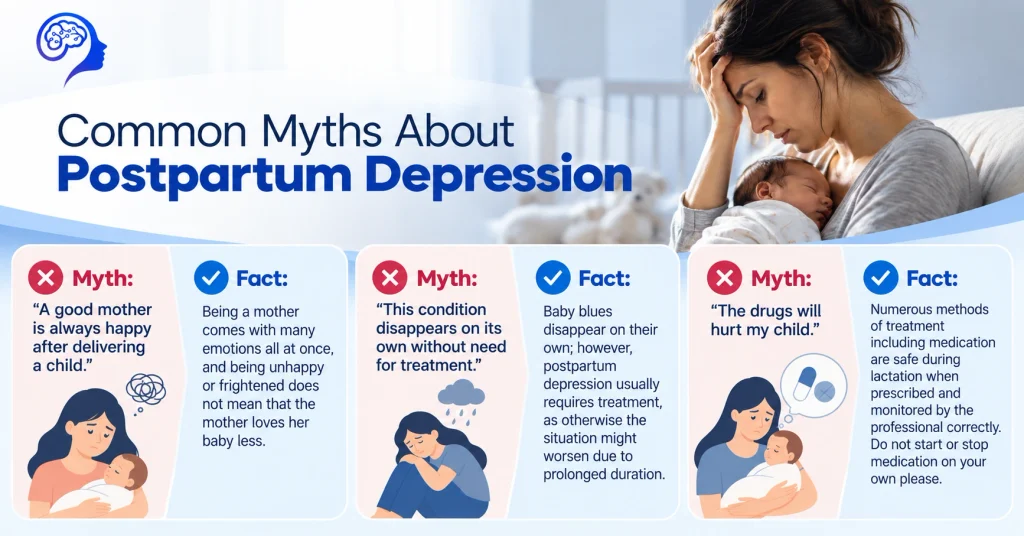
Myth: “A good mother is always happy after delivering a child.”
Fact: Being a mother comes with many emotions all at once, and being unhappy or frightened does not mean that the mother loves her baby less.
Myth: “This condition disappears on its own without need for treatment.”
Fact: Baby blues disappear on their own; however, postpartum depression usually requires treatment, as otherwise the situation might worsen due to prolonged duration.
Myth: “The drugs will hurt my child.”
Fact: Numerous methods of treatment including medication are safe during lactation when prescribed and monitored by the professional correctly. Do not start or stop medication on your own please.
How Is Postpartum Depression Diagnosed?
No single tests exist to diagnose the condition in question. The consultation with the psychiatrist who is a medical specialist in the field will be performed where he will ask you about your mood state, sleeping habits, eating and daily activities management as well as your health history. In addition, you may have some simple laboratory tests, for example, the thyroid test, to exclude other illnesses causing the symptoms. Should your condition not disappear within two weeks or get worse – it is necessary to visit a psychiatrist.
Postpartum Depression Treatment: What Works?
Perhaps the most positive aspect of postpartum depression is that it is possible to treat it and that women who receive proper treatment feel much better after.
1. Talk Therapy (Counselling)
A psychotherapist will listen to you and help analyze your feelings, coping mechanisms and manage stress. CBT, for example, is a method of treating postpartum depression that will make a person realize negative thoughts and start gradually replacing them with positive ones. More information on psychotherapy treatments in Jaipur can be found on our website.
2. Medications
If the depression is moderate to severe, the patient will have to take antidepressants prescribed by a specialist, since these medications help adjust neurotransmitters that affect mood. Antidepressants don’t act overnight, so they need several weeks before showing their effects. To see what duration they are needed, you should check the guide to antidepressants we have on the website. Please mention that you are breastfeeding your child so that the best medicine for both of you could be selected.
3. Family support and good habits
It is significantly easier to recover when the family stands behind the woman. In addition, a few small daily habits can make a difference:
- Use the opportunity to sleep whenever the baby goes to sleep, even briefly.
- Shift night feeding and housework responsibilities to your husband or any other family member.
- Maintain regular healthy food intake during the day.
- Go outside on a brief walk when the weather is bright, as both sunlight and physical activity have a positive impact on mood.
- Discuss your concerns with one person each day.
How can the family help?
Listening is the best way of family’s support without judgment or criticism of the woman and comparisons with other women. They can take care of household activities and night shifts so she could have enough sleep. Also, they shouldn’t say anything like “Just be happy” or “There are women who do that easily,” as it will raise additional feelings of guilt in her mind. First of all, they should persuade her to visit a doctor.
When Should You See a Psychiatrist?
If you have been feeling sad or anxious for more than 2 weeks; not able to sleep, eat or do the daily activities well; having no bonding with the baby or even having suicidal thoughts, then it’s time to visit a physician.
In case of an emergency, contact the mental health helpline or the nearest hospital.
Postpartum Depression Treatment in Jaipur: Meet Dr Sanjay Jain
If you are in search of the treatment of postpartum depression in Jaipur, you can get the compassionate treatment at a very nearby place.
Dr Sanjay Jain holds MD from SMS Medical College & Hospital Jaipur and has NLE (Pennsylvania, USA), CRA (Singapore), PGCPS degrees. He has an experience of more than 15 years in treating patients suffering from depression, anxiety and other mental health disorders and has helped more than 6,000 patients till date.
Why families prefer his clinic?
- The physician hears the complete history of the patient during the initial visit.
- The treatment is always customized for the individual and can include counseling, medication or both.
- All patient’s information is completely private.
- Patients are referred from Mansarovar, Vaishali Nagar, Vidhyadhar Nagar and many other parts of Rajasthan.
- He has a 4.7 rating on Google from more than 489 patients.
You can read more about Dr Sanjay Jain, or visit our pages on depression treatment in Jaipur and anxiety treatment in Jaipur, because anxiety often comes along with postpartum depression.
Conclusion
Now that you know what is postpartum depression, you can see that postpartum depression is common, it is a real thing, and it can be treated. Nothing is wrong with you and you don’t have to cope with it by yourself. The very fact that you ask for help shows that you are strong.
If you or your loved one requires professional help, book a consultation with Dr Sanjay Jain today.
Frequently Asked Questions (FAQs)
1. What is postpartum depression in simple words?
It is a profound mood of sadness, worry, and emptiness that persists after childbirth, is persistent, and goes beyond ordinary fatigue. It affects her ability to care for herself and her child.
2. How long does postpartum depression last?
It varies depending on individual circumstances. Under treatment, postpartum depression goes away for many women within several months, but without treatment, it may persist much longer, even for a year or longer.
3. Can postpartum depression be cured?
Yes, this condition is highly treatable. Psychiatric counseling, medication, and family support allow most women to recover from this disorder.
4. Can I take medications while breastfeeding?
Some medicines are relatively safe during breastfeeding period, and your psychiatrist will prescribe them to you carefully. Do not take or stop any medications without a prescription of your psychiatrist.
5. What is the difference between baby blues and postpartum depression?
Baby blues are mild and go away in two weeks, whereas postpartum depression is more serious, lasts longer, and interferes with daily life activities.
6. Is there a possibility that postpartum depression can occur many months after childbirth?
Yes, it may happen at any time during the first year and not just in the first weeks after delivery.
7. Will postpartum depression affect my baby?
It will, but not if it is treated. Untreated postpartum depression affects your ability to bond with your baby and take care of him/her.
Disclaimer: This blog is for information only and is not a substitute for medical advice, diagnosis or treatment.